Shadow AI Detection: See Every AI Tool Running Across Your Enterprise
Fruggr discovers the AI tools, models, and embedded AI features your teams are using, approved or not, and brings them into one governed inventory. You can’t govern what you can’t see.
Trusted by 40+ enterprise organizations across North America and Europe



What you can’t see can hurt you
Employees adopt AI faster than any approval process can keep up. Three risks emerge when no one has the full picture.
Unmanaged usage
Consumer chatbots, browser extensions, AI switched on inside software you already license: everyone uses them, nobody tracks them. You can’t build a coherent AI strategy on what you don’t know exists.
Data leaks and security gaps
Uncontrolled use of public AI services can send customer data, source code, and confidential documents to third parties, creating exposure your security team never sees.
Redundancy and hidden costs
When each department picks its own AI tool for the same job, subscriptions pile up with nothing added in value, and no one can say what the total bill is.
From shadow AI to a single source of truth: three capabilities
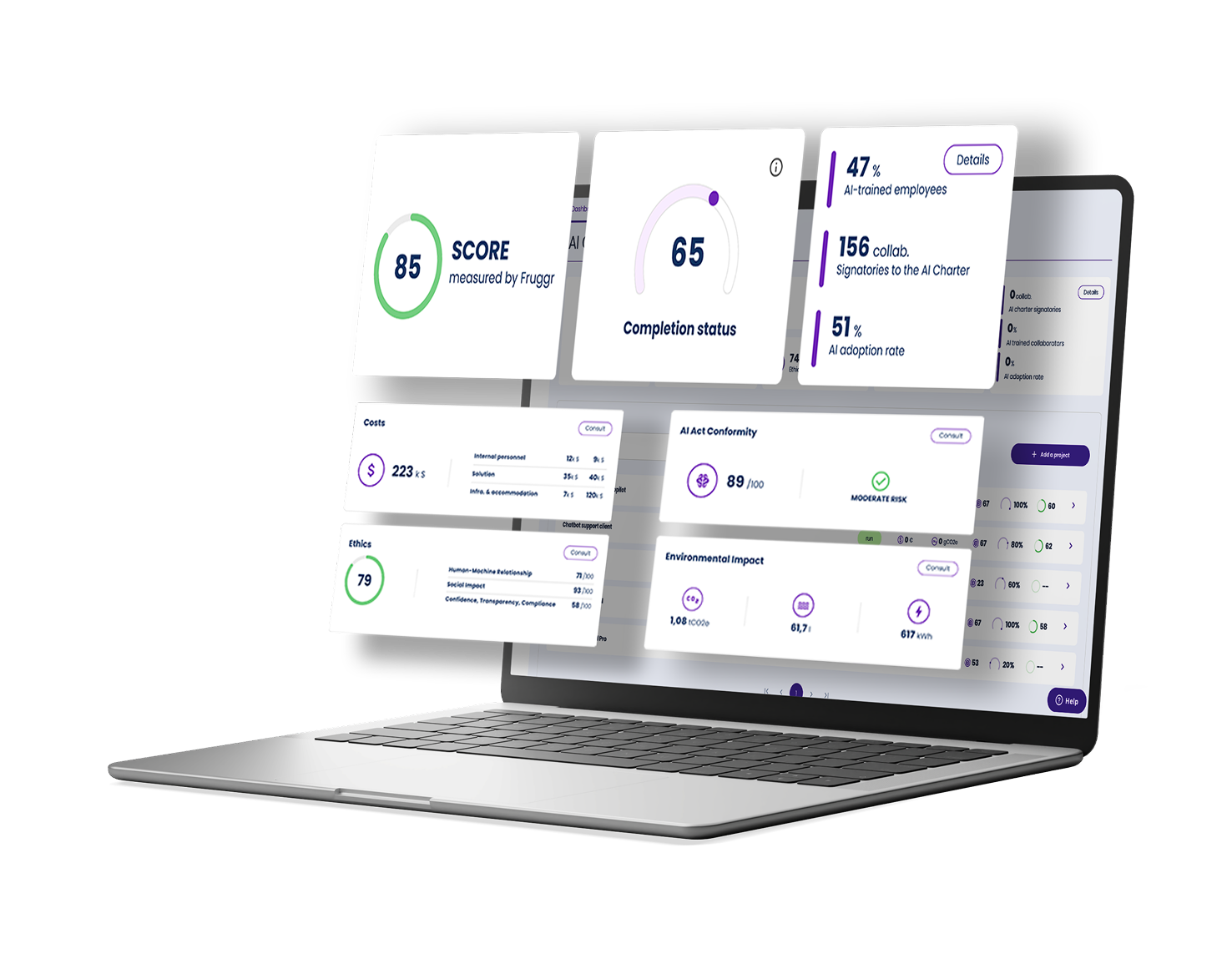
Fruggr discovers, inventories, and assesses every AI system
in one platform.
Surface shadow AI without slowing your teams down
A reliable picture of the AI actually in use, sanctioned or not.
- Automatic discovery of the AI tools, models, and features in use, including ones nobody approved
- Detection of AI embedded in the software your vendors ship
- Usage data (calls, token volumes, costs, teams) collected through standard OpenTelemetry from your existing observability tools
- A clear line between declared and undeclared usage
Result: you finally know which AI is in use, and who is using it.
See how Fruggr connects to your sources →One inventory for every AI system you run
A shared source of truth for IT, the business, security, and compliance.
- Internal systems, SaaS tools, and open-source models in one registry
- One record per system: owner, purpose, data involved, and cost
- A living inventory, updated as usage changes
- A common view for every decision-maker
Result: an up-to-date inventory, ready to feed your reports and audits.
Explore the AI inventory →Assess, classify, and assign accountability
Every system gets a risk level and a named owner.
- Quick criticality assessment for each AI system
- Risk classification aligned with regulations and your internal policies
- Deeper reviews triggered on security, ethics, or compliance
- Clear responsibilities across business, IT, and compliance
Result: decisions based on real risk, not guesswork.
See how risk maps to regulations →From discovery to governance in 4 steps
Fruggr is a SaaS platform: nothing to install or host. It reads usage data from your existing observability tools through OpenTelemetry, without replacing them. Typical implementation: 1 to 3 months, depending on scope.
Discover
Fruggr collects usage telemetry through OpenTelemetry and surfaces the AI systems in use, declared or not.
Inventory
Each system joins the registry with an owner and a purpose.
Assess
Each system gets a risk level and, when needed, a deeper review.
Decide
Fruggr suggests next steps; you decide whether to approve, put guardrails on, replace, or retire each tool.
Built for the U.S. AI governance landscape
There is no single federal AI law, but frameworks and state rules keep multiplying. Every one of them starts with the same question: which AI systems do you actually have?
NIST AI RMF
The framework most U.S. enterprises benchmark against. An accurate, current AI inventory underpins its Govern and Map functions, and Fruggr keeps it live.
See NIST AI RMF alignmentState AI laws
California, Colorado, and other states are adding AI obligations. Knowing which systems you run, and what they do, is the first step to knowing which rules apply to you.
Explore AI regulationsNYC Local Law 144
Automated hiring tools can require bias audits. HR teams adopt AI quickly; the inventory helps you spot which tools may be in scope before an auditor does.
Read about Local Law 144Shadow AI, through every leader’s lens
Each stakeholder gets the visibility they need in Fruggr.
CISO and security teams
Cut data exposure before it becomes an incident.
- Every AI tool in use, including the ones that bypass IT
- Risky usage flagged, with suggested actions, before it causes a breach
- A risk level attached to each system
CIO and Chief AI Officer
Take control of your AI estate without stalling innovation.
- One inventory of internal, SaaS, and open-source systems
- Tool-by-tool decisions: approve, guardrail, replace, or retire
- A solid base for scaling AI across the enterprise
General Counsel, Privacy, and Compliance
Know which systems touch which data.
- An up-to-date record of AI systems and their purposes
- Owners and responsibilities identified for each system
- Data ready for audits and regulatory reporting
CFO and Procurement
Eliminate duplicate tools and unused licenses.
- Overlapping tools spotted across departments
- Costs tied to each system in the inventory
- Hard data to renegotiate or cancel contracts
Turn ad hoc AI usage into managed usage
Shadow AI is often a sign of a real need on your teams. Fruggr helps you recognize it, then decide: approve the tool, put guardrails around it, offer an alternative, or retire it. Once your inventory is in place, you can track the value of every AI initiative and stay on top of your obligations.
Your questions about shadow AI
What is shadow AI?
Shadow AI is any AI tool, model, or feature used inside an organization without review or approval from IT, security, or compliance. That includes consumer chatbots, browser extensions, AI features switched on inside software you already license, and models a team deployed on its own.
Why is shadow AI a risk for enterprises?
It exposes sensitive data to services nobody vetted, multiplies overlapping tools and subscriptions, and makes it impossible to say which AI systems are actually in use. Without that visibility, it is hard to demonstrate compliance, answer an auditor, or steer AI investment.
How is shadow AI different from shadow IT?
Shadow IT is unapproved software or hardware. Shadow AI is harder to spot: it often arrives as a feature inside an approved application, or as a browser tab an employee opens in seconds. It also raises specific risks, such as company data being sent to third-party models and decisions being made by systems no one has assessed.
How does Fruggr detect undeclared AI usage?
Fruggr collects usage data through standard OpenTelemetry from your existing observability tools to surface tools and models that appear in no registry, then attaches an owner and a risk level to each one. Fruggr is a SaaS platform, so there is nothing to install or host.
Should we ban unapproved AI tools?
Not necessarily. Blanket bans tend to push usage further underground. The goal is to know what is in use so you can decide tool by tool whether to approve it, put guardrails around it, replace it, or retire it, without slowing your teams down.
What is an AI inventory (or AI registry)?
An AI inventory is a single record of every AI system in your organization, with an owner, purpose, data involved, cost, and risk level for each. It is the foundation for cost control and compliance, including alignment with frameworks such as the NIST AI RMF. Learn more about AI performance and ROI and AI compliance.
How long does it take to get started?
Implementation typically takes one to three months, depending on scope and the number of sources to connect. Fruggr typically detects about 70% of shadow AI usage within 8 weeks of subscribing.
See your shadow AI before it becomes a problem
Book a demo and we’ll show you how Fruggr surfaces undeclared AI and builds your inventory.